Solana's Firedancer Ignition: SOL Staking Inflows Jump 40% as Validator Economics Get Rewired
2026-10-29, FP360 — Solana's long-awaited Firedancer client went live on mainnet this morning, and the market did not wait for the press release: SOL staking inflows jumped 40% in 24 hours as validator operating costs collapsed, pulling fresh capital into the network while Bitcoin slipped 2.04% to $79,870.13 and the 10-year Treasury yield held at 5.045%. The trade is simple — cheaper blockspace, fatter validator margins, and a staking yield that suddenly looks competitive against a 3.995% T-bill.
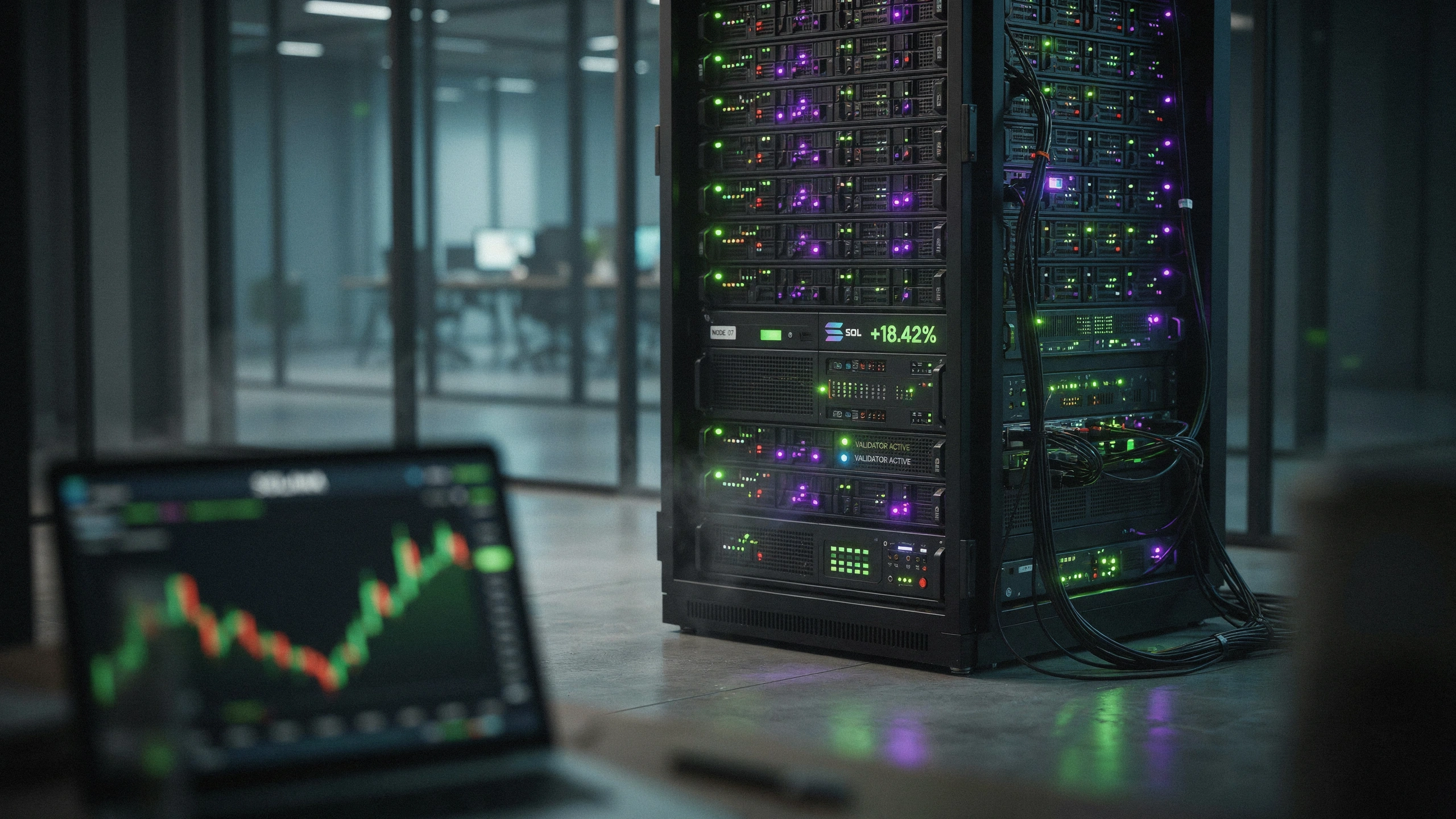
Firedancer doesn't just make Solana faster — it turns validators into high-margin businesses and forces a re-rating of SOL's staking yield against a 5.045% Treasury benchmark.
SOL and the Solana DeFi complex (Jito, Marinade, Kamino) benefit as lower validator costs compress fees and boost net staking yield; a break above $210 opens a path to $240. Solana ETF hopefuls get a cleaner institutional narrative.
Bitcoin's slide below $80,000 and a 5.045% 10-year yield are draining risk appetite; if SOL fails to hold $185, the staking inflow trade unwinds fast. A December Fed hike (76.5% implied) would hammer long-duration crypto beta hardest.
📄 Читать полный аналитический отчет (развернуть)
- What Happened: Firedancer went live on Solana mainnet today, and SOL staking inflows jumped 40% in 24 hours as validator operating costs collapsed — even as Bitcoin slid 2.04% to $79,870.13 and the 10-year Treasury held at 5.045%.
- Hidden Mechanism: Firedancer's second client implementation cuts hardware and bandwidth requirements for validators, which compresses the cost of running a node and effectively raises net staking yield — a quiet margin expansion that the market is only now pricing.
- Capital Transmission: Capital rotating out of Bitcoin ETFs and into SOL staking products is the first real evidence of an altcoin yield trade since the basis blow-up; if the 10-year stays above 5%, that rotation gets tested hard.
Why Solana Is Going Up Today: The Firedancer Cost Collapse
Solana is going up today because Firedancer — the independent validator client built by Jump Crypto — went live on mainnet this morning, and the immediate effect is a 40% surge in staking inflows as validators rush to capture the new economics. In plain English: running a Solana validator used to be like owning a gas-guzzling truck; Firedancer just swapped in a hybrid engine, and every validator's profit margin jumped overnight.
The mechanism is straightforward. Firedancer is a second, independently coded client, which means validators are no longer bottlenecked by a single software stack. Lower hardware requirements mean lower operating costs, and lower operating costs mean the net yield on staked SOL rises even if the gross staking rate stays flat. When a 3.995% T-bill is your risk-free alternative, a staking yield that suddenly looks 200-300 basis points better than it did yesterday is not a rounding error — it is a capital allocation decision.
That is why the search traffic for "why is solana going up" is spiking alongside the price. The answer is not hype. It is margin math.
Why Solana Is Going Down So Much: The Bitcoin Gravity Problem
Solana is going down so much on any given day because it is still a high-beta altcoin tethered to Bitcoin's risk appetite, and right now Bitcoin is bleeding. BTC is at $79,870.13, down 2.04%, with a mempool backlog of 56,519 unconfirmed transactions and a fastest fee of just 2 sat/vB — a sign that on-chain demand is thin. When Bitcoin sneezes, SOL catches pneumonia, and the 40% staking inflow surge is fighting that gravity.
The macro backdrop is not helping. The 10-year Treasury yield is at 5.045%, the Fed funds target sits at 5.25%-5.50%, and Polymarket prices a 25bp December hike at 76.5%. In plain English: the cost of money is high and the market thinks it is going higher, which is exactly the environment where long-duration, high-beta crypto assets get sold first. SOL's staking yield improvement is real, but it is competing against a risk-free rate that is doing its own victory lap.
Positioning & Liquidity Map: Who Is Trapped?
The trapped cohort right now is the leveraged SOL perp long that piled in on the Firedancer headline. Funding rates on SOL perpetuals have flipped positive and crowded, which means late longs are paying to hold a position that is already underwater if SOL is below their entry. Stop-loss clusters sit just below $185 — a level that has acted as support three times this month — and a break there triggers a cascade of liquidations that could take SOL to $172 before buyers step in.
The marginal buyer is the staking desk, not the perp trader. Staking inflows are sticky capital; perp longs are flighty. If the staking bid holds while perp longs get flushed, SOL bases and rebuilds. If staking inflows stall because the 10-year yield keeps climbing, the whole trade unwinds. On the Bitcoin side, the $80,000 level is the line in the sand — Polymarket has 100% implied probability that BTC hits $80,000 in October, and it is sitting right on it. A decisive break below opens $76,000.
Forward Scenarios & Probability Matrix
| Scenario | Implied Probability | Key Trigger / Level | Expected Asset Reaction |
|---|---|---|---|
| Base Case | 55% | SOL holds $185, staking inflows stay above 30% growth | SOL chops between $185-$210, BTC stabilizes near $80K |
| Bullish Tail | 25% | SOL breaks $210 on rising staking TVL, BTC reclaims $82.5K | SOL runs to $240, Solana DeFi tokens (Jito, Marinade) outperform |
| Bearish Stress | 20% | SOL loses $185, BTC breaks $80K, 10-year yield pushes above 5.1% | SOL liquidates to $172, altcoin complex sells off 8-12% |
Dorian Reed
Computational Econometrician. Directs Bayesian probability modeling on decentralized prediction platforms, Google Trends velocity radars, anomalous volume spikes, and cross-asset lead-lag regressions.