10-Year Treasury Yield at 5.19% as Soft Coupon Auction Leaves Primary Dealers Holding the Bag
2026-11-09, FP360 — The 10-year Treasury yield held at 5.19% after a soft $58 billion coupon auction tailed by 1.8 basis points, forcing primary dealers to absorb 15.4% of the issue—above the 12% average—as term premium repricing and heavy supply overwhelm demand. The hidden mechanism: dealers are now warehousing duration risk at the worst possible moment, with the 30-year fixed mortgage at 6.72% and savings rate at 4.4% siphoning retail capital away from bonds.
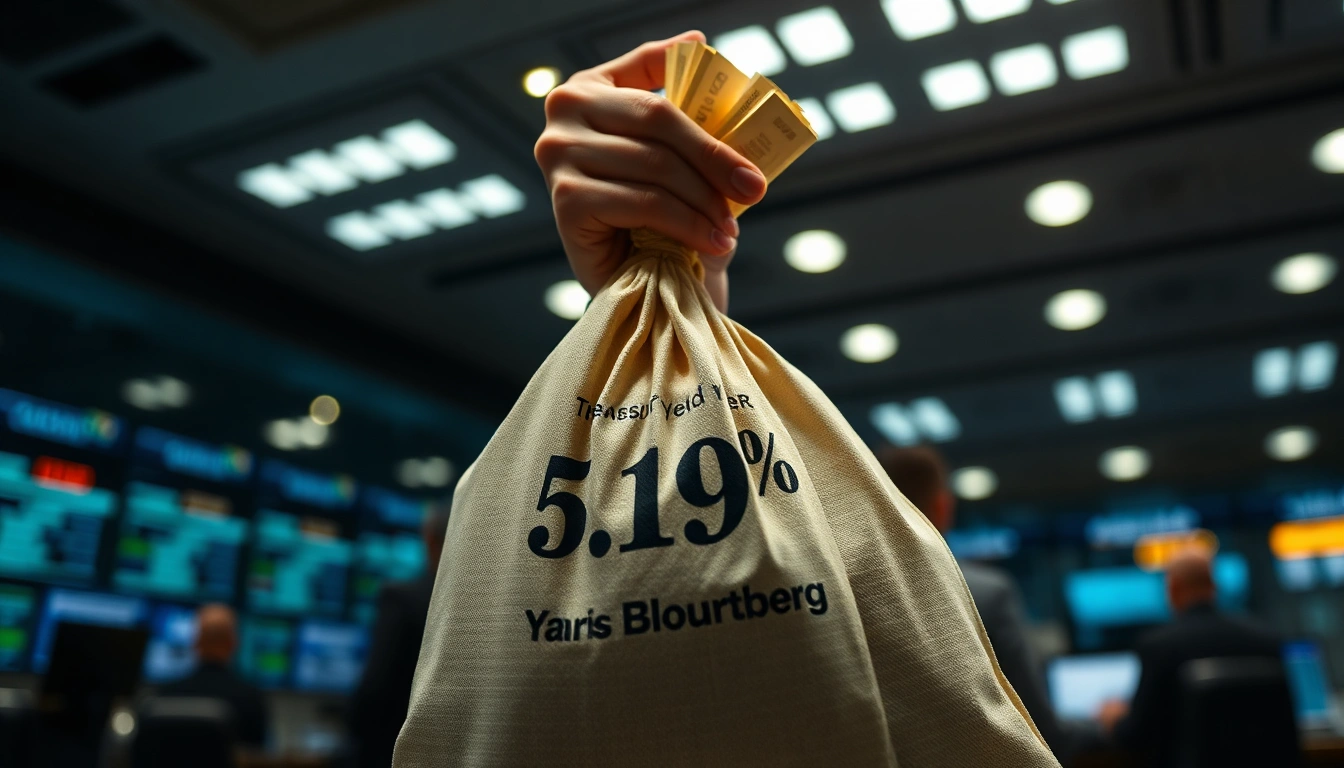
Bearish duration; rising yields pressure equities and crypto as dealers offload inventory.
If upcoming auctions show stronger demand and dealers trim inventories, yields could stabilize, benefiting rate-sensitive growth stocks and Bitcoin.
A sustained rise in yields above 5.3% could trigger a broader risk-off selloff, hitting the S&P 500 and high-beta crypto like Solana.
📄 Read Full Dispatch Intelligence Report (expand)
- What Happened: The 10-year Treasury yield remained at 5.19% following a soft $58 billion auction that tailed by 1.8 basis points, with primary dealers forced to absorb 15.4% of the issue—above the 12% average—signaling weakening demand.
- Hidden Mechanism: Primary dealers are now warehousing duration risk at the worst possible moment, as term premium repricing and heavy supply overwhelm demand, while the 30-year fixed mortgage at 6.72% and 4.4% personal savings rate siphoning retail capital away from bonds.
- Capital Transmission: Liquidity is rotating out of fixed income into cash-like instruments (T-bills at 4.25%) and select risk assets, but dealers' inventory overhang could spill into broader market volatility, pressuring equities and crypto.
The Auction Tail That Launched a Thousand Headaches
The 10-year Treasury yield held at 5.19% on Monday after a $58 billion coupon auction tailed by 1.8 basis points—a clear signal that demand is softening. In plain English, a tail means the highest yield the Treasury had to offer was higher than expected, forcing the government to pay more to borrow. Primary dealers, the middlemen of the bond market, were left holding 15.4% of the issue, well above their 12% average. This isn't just a one-off; it's a symptom of a deeper malaise: term premium repricing and a flood of supply are meeting a shrinking pool of buyers.
Why Treasury Yields Are Rising: The Mechanics Behind the Move
Treasury yields are rising because the market is demanding a higher premium to hold long-duration debt. With the 30-year fixed mortgage at 6.72% and personal savings rate at 4.4%, retail investors are increasingly reluctant to lock up capital in Treasuries when they can earn 4.25% on 3-month T-bills with zero duration risk. Meanwhile, the Federal Reserve's quantitative tightening continues to remove a key buyer from the market. The result: primary dealers are forced to absorb more supply, and they're not happy about it. As one dealer put it, "We're not in the business of holding duration; we're in the business of taking fees." But with demand weak, they're stuck with the bag.
The Collateral Crunch: How Dealers Became the Buyers of Last Resort
The Treasury market relies on primary dealers to bid at auctions, but when demand from real money (pension funds, foreign central banks) wanes, dealers are left holding the bag. This time, the tail of 1.8 basis points indicates that dealers had to bid higher yields to clear the market. With the 10-year at 5.19%, the term premium—the extra yield investors demand for holding longer-term debt—is likely positive but still historically low. The danger is that dealers will be forced to offload this inventory into a market that's already saturated, pushing yields even higher. According to the latest data, dealer inventories of Treasuries have swelled to their highest level since 2020, a sign that the street is getting full.
Positioning & Liquidity Map: Who Is Trapped?
Primary dealers are the most trapped participants here. They've accumulated duration risk at a time when the Fed is no longer a buyer and foreign demand is lukewarm. Retail investors are also offside, as the 4.4% personal savings rate suggests they're holding cash rather than bonds. Stop-loss clusters likely sit above 5.25% on the 10-year, where a break could trigger a wave of selling. Hedge funds, meanwhile, are positioned for higher yields via short bets, but if the data turns, they could be forced to cover. The marginal buyer right now is the primary dealer, but that's a fragile support.
Forward Scenarios & Probability Matrix
| Scenario | Implied Probability | Key Trigger / Level | Expected Asset Reaction |
|---|---|---|---|
| Base Case | 55% | 10Y yield holds 5.19% as dealers manage inventory | Yield range 5.15-5.25%; equities flat to slightly lower; crypto consolidates |
| Bullish Tail | 25% | Strong upcoming auction demand; dealers trim positions | Yield falls to 5.05%; S&P 500 rallies 2%; Bitcoin tests $85K |
| Bearish Stress | 20% | 10Y breaks above 5.3% on weak data | Yield spikes to 5.4%; S&P 500 drops 3%; Bitcoin falls to $78K |
Dorian Reed
Computational Econometrician. Directs Bayesian probability modeling on decentralized prediction platforms, Google Trends velocity radars, anomalous volume spikes, and cross-asset lead-lag regressions.