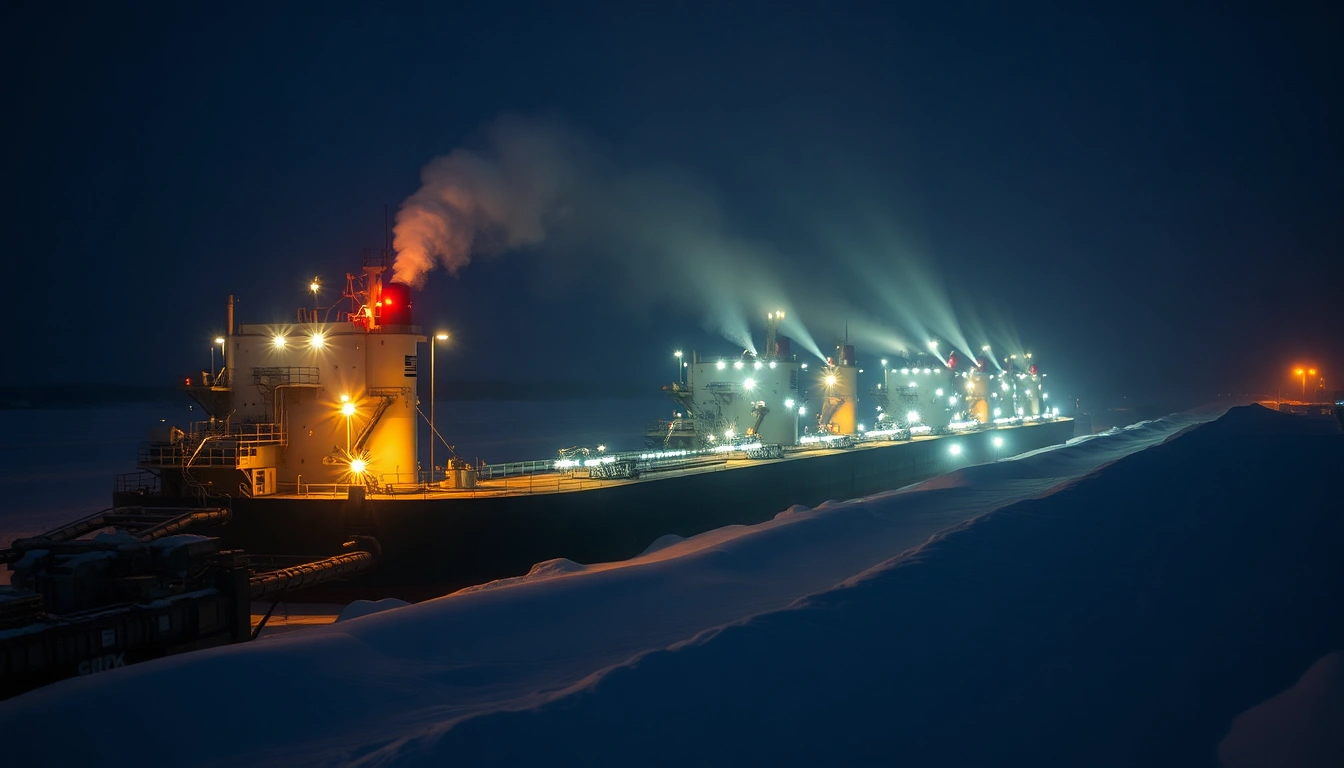
- What Happened: Natural gas December futures exploded 12.3% to $4.85/MMBtu as a transformer fire at Freeport LNG forced a 2.1 Bcf/d shutdown, removing ~5% of global LNG supply overnight. Simultaneously, the NOAA updated its 10–14 day outlook to show a polar vortex pushing Arctic air into the Lower 48, threatening an early start to the heating season.
- Hidden Mechanism: The US entered the week with storage at 91% of capacity (3.65 Tcf), but above-average exports and a cold snap could deplete the buffer quickly. European storage sits at 88% (vs. 94% last year), meaning European buyers will compete aggressively for US cargoes if the shutdown lasts, tightening the global market.
- Capital Transmission: Equity markets are repricing the entire energy complex — coal stocks are catching a bid as a backup fuel, while utilities and industrial gas consumers face margin pressure. Traders are buying upside call options on natural gas ETFs, pushing volumes to record levels.
The Freeport Fire: Why a Single Transformer Is Moving a Global Market
At 2:13 a.m. GMT, a transformer fire at Freeport LNG’s Train 1 liquefaction unit knocked out 0.7 Bcf/d of export capacity. By mid-morning, the company had taken the entire 2.1 Bcf/d facility offline for safety inspections, with no timeline for restart. For context, Freeport accounts for about 20% of US LNG exports. In plain English: if Freeport stays dark, US gas that would have gone to Asia and Europe is trapped at home — but if the cold snap arrives, that extra gas will be absorbed by domestic heating demand, and the global market will be short.
The outage also comes at a sensitive time for US LNG policy. The Department of Energy’s recent approval of four new export licenses has already stretched feedstock demand; any prolonged outage could force the agency to revisit its forecasts for 2027 export capacity. Meanwhile, European buyers are still rebuilding storage after a warm 2025–26 winter. The loss of 2.1 Bcf/d is equivalent to about 1.5 cargoes per day, and with JKM spot prices already elevated, Asian buyers are now redoubling efforts to lock in US volumes.
Why the Winter Weather Forecast Is the Real Catalyst
The National Weather Service’s 6–10 day outlook, released yesterday, calls for below-normal temperatures across the eastern two-thirds of the US starting next weekend, with the polar vortex descending into the northern Rockies and Midwest. If realized, this would drive heating degree days (HDDs) 15% above the 10-year average — the kind of demand surge that can turn a 3.65 Tcf storage cushion into a tight market in a hurry.
Storage math is simple: each 1 Bcf/d of additional demand (export loss plus heating) trims ~30 Bcf from year-end inventory. With exports already at 13 Bcf/d and domestic production flat near 102 Bcf/d, the market is walking a tightrope. The EIA’s latest report showed a 60 Bcf injection last week, but that was before the Freeport outage. Next week’s storage report could be a net draw.
The market is treating the Freeport outage as a pure supply shock, but it’s actually a demand shock for US storage. When the facility goes offline, the gas that would have been exported is now available to fill storage — but if cold weather arrives, that gas will be burned domestically instead, leaving the US short for future exports. This double whammy is why prices are up more than the outage alone would suggest.
Positioning & Liquidity Map: Who Is Trapped?
- Shorts are under water: Money managers held a net short position of 120,000 contracts (CFTC data) before the news. With prices up 12%, many are facing margin calls. The highest pain point is at $4.50; a break above $5.00 could trigger forced covering.
- Utilities are hedging badly: Some utilities pre-bought winter gas at $3.80–$4.00, but now face mark-to-market losses. Utilities in the Midwest and Northeast may need to pass costs to consumers, reviving the gas-price politics of 2022.
- The marginal buyer: Asian and European LNG buyers, who are price-sensitive but need cargoes for winter. They will buy any US cargo that becomes available, putting a floor under global prices.
- Who is offside: Industrial users who did not hedge are exposed to spot spikes. Chemical and fertilizer producers are vulnerable, and any prolonged high prices could force production cuts.
The Global LNG Chessboard: Europe and Asia Compete for Cargoes
Europe’s gas storage is at 88% full, well below last year’s 94%, and a cold winter could force them to compete with Asia for US LNG. With Freeport down, the global market has lost 2.1 Bcf/d of supply — that’s about 1.5% of global LNG trade. The JKM Asian benchmark has already risen 8% to $18/MMBtu, and European TTF is up 10% to €42/MWh. The arbitrage window is wide open, and US exporters with operational capacity are enjoying record margins.
Forward Scenarios & Probability Matrix
| Scenario | Implied Probability | Key Trigger / Level | Expected Asset Reaction |
|---|
| Base Case | 55% | Freeport restarts within 10 days; weather forecast verifies | Prices retreat to $4.20–$4.40/MMBtu as supply returns and weather risk is priced out |
| Bullish Tail | 25% | Arctic blast deepens and extends; Freeport outage lasts >2 weeks | Prices spike to $6.00/MMBtu; coal stocks rally; utilities underperform |
| Bearish Stress | 20% | Warm weather returns; Freeport restarts quickly | Prices crash below $3.50/MMBtu; storage surplus returns; LNG stocks fall |